From 12 to 17 October 2026, Marseille hosted the 26th ICID International Congress, bringing the international agricultural water community together around a single question: how to strengthen agriculture’s resilience to climate change.
Under the theme “Water and Agricultural Resilience in the Face of Climate Change”, the congress convened researchers, engineers, farmers, public decision-makers, international organisations, consulting firms, companies and NGOs. Its purpose was to connect scientific knowledge, field experience and operational solutions, in support of an agricultural sector that is productive, water-efficient and able to adapt.
The programme was built around three main lines of enquiry:
That third question is the one that framed much of the rest. It moves the conversation from the field to the basin, and from optimising a single farm’s water use to managing a shared resource.
The professional exhibition set out an ecosystem of solutions, from irrigation equipment to monitoring and management tools: connected sensors, remote sensing, satellite data, modelling, advisory services and digital decision-support.
For local and regional stakeholders, these technologies help assess crop water requirements, monitor soil-water conditions, anticipate periods of water stress and adjust water applications to match actual conditions. The challenge is what comes next: embedding these tools within coherent basin-scale strategies, so that technical solutions genuinely serve water conservation and collective resilience rather than sitting alongside it.
That is the gap BWI came to Marseille to discuss.
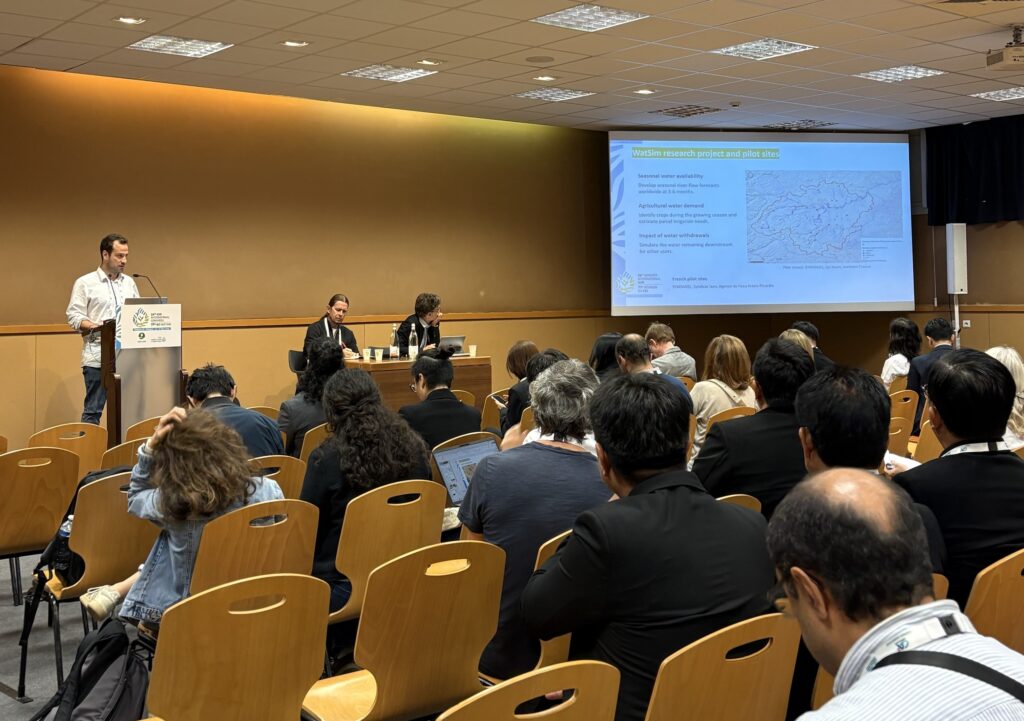
Benoît Nigon, hydrogeologist at BWI, presented WatSim in the Smart Irrigation session. The project couples seasonal river-flow forecasts with Earth observation-based estimates of irrigation demand, bringing the two sides of the equation into the same view.
In practice, WatSim aims to anticipate water availability over a three to six month horizon, identify crops during the growing season, and simulate the impact of abstractions on downstream flows, so that planning and allocation decisions can be made on evidence rather than on the previous year’s assumptions.
Beyond the sessions, ICID 2026 served as a meeting point for institutions, scientific communities and solution providers from across the world. That international dimension mattered: it allowed experiences to be compared between territories facing very different water constraints but sharing the same underlying challenges around adaptation, food security and the preservation of water resources.
For BWI, taking part in ICID 2026 and presenting WatSim was a way to position hydrological modelling and hydrogeological expertise as practical levers for agriculture that is more resilient, more water-efficient and better prepared for climate uncertainty.